The empire is growing
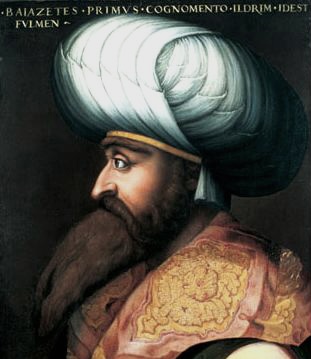 The Turkish state has become a real power after that, like Murad and defeated the Serbs in the great battle of Kosovo field 1389 r. Nobody could stop the Turkish pressure to the Balkans anymore and soon the Turks mastered all of Bulgaria (for the successor of Murad – Bejazyda I Błyskawicy), They joined large areas of Albania and Macedonia and entered, After crossing the Danube, to the areas of today's Romania. Lightning (should. Yildirum) He even tried to get Constantinople. Actually, only this city remained in the hands of the Byzantine Empire, not counting the independent monarchy with the capital in Trapezuntie and a few insignificant enclaves, and all of Anatolia was incorporated into the Ottoman state. Only a few Emirates were able to maintain relative independence. There was danger in Kosovo over Europe, which mobilized and united European knights under the slogan of the defense of Christianity. Under the leadership of the King of Hungary Zygmunt Luxembourg, he suffered a defeat with the Turks at Nikopolis in 1396 r. The road to Europe was open to Islam.
The unexpected salvation came from the east. At the end of the fourteenth in. Mongolian ruler Timur Lenk (Kulawy), A descendant, Known in Europe as Tamerlan, united the Central Asia state and wanted to take an even larger area. First, he directed his steps towards Persia and India, Then Aleppo and Damascus won, and then he entered Anatolia. In the battle of Ankara in 1402 r. He beat the Bejasid army and took him captured, where he gave up his ghost. Many of the Emirates recently conquered by the sultan of the Osman, Tamerlan's tribute began to pay, and the sons of Bejasid got a small scrap of land in the possession.
After the death of Tamerlan, there was a crisis in the Mongol state, As a result, the plans of Turkish expansion could be reborn. Mehmed 1(1413-21) He dealt with his brothers and became a sultan, having united the divided state. His son Murad II entered the Balkans again and was looking for a disgust with Hungary. W 1444 r. Europeans organized a relief headed by the King of Hungary and Poland Władysław III, they suffered a terrible defeat, And Władysław was injured fatally wounded. After this battle, the young king gained the nickname Warneńczyk. Another battle took place during Murad II's reign – again under Kosovo field (1448) – And again Europe suffered a defeat. The rebellion against the Turkish authority in Albania, however, weakened the impetus north. His son Mehmed II became the successor of Murad II, later called Fatih, So the winner, which reigned in the years 1451-81. He became famous primarily for winning Constantinople in 1453 r. – From then on, the end of the Middle Ages dates (Middle Ages) and the beginning of modern times, Because it was a breakthrough moment in the history of the then world. Constantinople became the capital of the Ottoman Empire and was renamed Istanbul (pol. Istanbul). Byzantine Empire, A real refuge of Christianity in this part of the world, It ceased to exist, after its over-thousand, turbulent history. The Turkish Sultan has now considered the successor of the Roman Bizantic Empire and claimed the right to unite under the Islamic banner of all Muslim tribes and Greeks, who were the memory of the former Empire, second Rome.
After a huge success, What was the acquisition of Constantinople, Mehmed II set off to conquer the remains of independent states inside Anatolia. He defeated karamanids (with the capital in Karamań), Turkmen in Eastern Anatolia and the last Christian state in this plateau – the kingdom of trapezuntu (1461). Even earlier he won Serbia, Belgrade was unsuccessfully besieged (1456), He mastered Peloponnese and Athens, and also waged a war with Venice. He also directed his steps towards Wallachia and Moldova, reaching the boundaries of the then Poland, and then without major obstacles he subordinated the Crimean Chanate.