Władysław Jakub Filipkowski
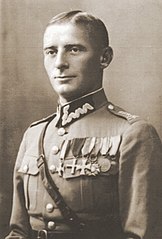
The officer serves the permanent artillery of the WP: maiden (1 V 1919), Lieutenant (15 VIII 1924), colonel (1 And 1931), posthumously the gene. brig. (28 IX 1994), PS. “Cis”, “Janka”, “Energy”, “Steam”.
Ur. 1 house 1892 in Filipów, pow. Suwałki, Son of Dominik and Anna of D. Łopieńska, from the landed family. He graduated in 1909 Trade Junior High School in Suwałki obtaining a high school diploma, and in 1909-1914 He studied at the Faculty of Law of the University of Lviv, obtaining discharge and by 6 semesters at the Faculty of Machines of the Polytechnic School in Lviv. At that time he was a member of the Shooting Association. From 1 VIII 1914 He served in the legions (And staff battery, then 1 artillery regiment) Subsequently as a commander, it works, platoon, Intelligence officer and Adiutant Dyon Haubic, being appointed to the stage of the ensign (14 III 1915) and lieutenant. (1 V 1916).
He fought in the Carpathians, in Bukowina and Volhynia. After the oath crisis from 22 VII 1917 do 1 XI 1918 imprisoned by the Germans, m.in. He was interned in Szczypiorno, and then in Rastatt and Werl. From 5 XI 1918 in WP, First, as he was a clerk at the Artillery Inspectorate in Warsaw, and from 29 XI 1918 Adiutant in the general adjutant of the Commander -in -Chief. From 11 II 1919 commanded the battery in 2 pop, Then from 1 XI 1919 do 15 VII 1921 He managed the Second Department of the Staff (counterintelligence) The verdict. Lviv, in this position “turned out to be a great manager” And he created “An excellent information and defensive apparatus on this difficult terrain”. From 16 VII 1921 He was in 1 Pal the commander of the dyon, Deputy Commander of the Regiment from 11 II 1922, and from 21 And 1927 do 15 XII 1935 commander 1 pal. During the May coup, he replaced the absent commander of the regiment and decided to support the coup, sending help to Piłsudski. At last 1935 took the position of the commander and artillery group in Warsaw (artillery and doc), a 30 III 1936 Deputy II Deputy Minister of Military Affairs – The head of the Army Administration, and in this respect he occupied from 1 IV 1936 do 15 V 1937 position of the President of the Administrative Council of the State Engineering Plant in Warsaw. He was also a member of the Command of the Supreme Association of Polish Legionnaires from 24 V 1936, appointed to her at the 13th Congress of the Union by his commander -in -chief, colonel. Husband to the man. In June 1938 He became the commander of the divisional infantry 16 DP, And in July 1939 He switched to the same position in 1 DPLeg.
While playing this function, he took part in the September campaign, in which 1 DPLeg. She fought as part of the army “Modlin”. Then at the end of September 1939 He commanded an independent group (the so-called. by the F-EGA group). It included forces from the current crew of Brest and a number of smaller troops, a 27 IX above her and a few other groups – The command was taken by Colonel. deep. Tadeusz Zieleniewski. She fought in the Lublin region for surrender 2 X. He was captured by Soviet and was taken to Lviv, But he managed to escape there and get to Otwock, and then to Warsaw. Apparently, he was then expected to be the commander of the SZP-ZWZ Kraków District. W 1941 He was active in the underground “Discussion group”, appointed by an activist of the National Party (SN), Tadeusz Kobylański, and composed of representatives of the Supreme Court, PPS and Sanacja. From 1940 by the end of July 1943 He was an AK KG inspector for the Lviv area. Then he commanded this position from 1 VIII 1943 do 31 VII 1944. Managed the forces of the area in progress “storm”, from 30 VI 1944 preparing to reorganize the command of the area into the Corps District Command No.. VI. In dealing with the Soviet command, at the consent of the KG, the AK used the title of the general, At the head of the delegation of the area of the area, he went 31 VII for conversations with the gene. M. Żymierski to Żytomierz, Then, after their completion, he was arrested at night together with the accompanying officers 2/3 VIII 1944. Then he was detained in a central prison in Kiev, and then transported at the disposal of the counterintelligence and the Ukrainian Front to Lviv, Rawa Rawa and Trzebuski 22 km north of Rzeszów. 5-6 IX 1944 transported by plane to the camp in Kharkov, Then he was imprisoned in Ryazan-Diagilewo from 5 And 1946, in Griazowiec from around 15 VII 1947 and in Brest from 18 X 1947. In November, he was transported to Poland and released in Biała Podlaska. Then he worked at the glassworks in Pieńsk near Zgorzelec as the administrative director of the Hut team. He died in Pieńsk 17 April 1950 and was buried in a family grave at the Powązki cemetery in Warsaw.
He was awarded, among others. Military virtues 5 kl. (1922), 2-Krotnia with the Cross of the Valor (1922), The Golden Cross of Merit (1928), Independence Cross (1931), Order of the Rebirth of Poland 4 kl. (1936), The Commander's Cross with the Order Star “Romania crown” (1939), Commander's Cross of the Order “Romania stars” (1937) and medals.
Married to Janina Obidzińska, which during the occupation was a soldier of the Home Army in North Mazovia, PS. “Grabina”. He had sons Jan (ur. 1922), student of the Warsaw University of Technology and a regiment soldier “Fuck”, which has fallen in the last days of the Warsaw Uprising and Andrzej (ur. 1925), AK soldier in northern Mazovia, pS. “Bohdan”, Participant in guerrilla fights from 1943, political prisoner 1948-1956.
Orders and decorations
Silver Cross of the Virtuti Militari War Order (1922)
Officer's Cross of the Order of Polonia Restituta (1936)
Independence Cross (1931)
Cross of Valor – twice (1922)
Golden Cross of Merit (1928)
Commander's Cross with the Order Star “Romania crown” (1939)