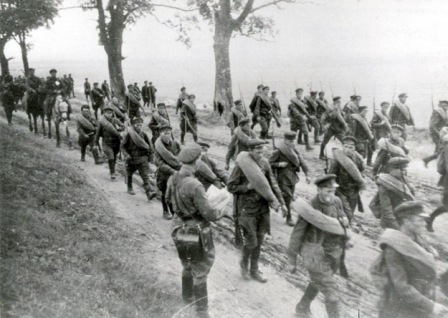
 Red Army
In the mid-years 30. 20th century, Red Army Workers' and Chłopska (Rkka) As Polish general Stachiewicz rated this, “It stands out on the greatest military power of Europe”. It was in fact. While, When he spoke these words, The Red Army was the strongest and best equipped with technical equipment around the world. Alarming number 170 Division supported by over 20 000 tanks and 15 000 aircraft was enough, to discourage anyone to war with the Soviet Union.
However, Contrary to appearances, The Red Army was not a very dangerous opponent in battle. Despite the breathtaking numbers, They did not reflect the actual military potential of the Soviet armed forces. 170 Soviet divisions was in fact a group, who joined the army in search of a better life than in the role. Their uniforms were often not complete, Military jackets were replaced by ordinary cotton pads, and rifles, or pistols, They wore on strings, with the number of hearing cartridges was not enough to conduct longer fights. Soviet soldiers could not fight, and the only advantage on the battlefield was given to them by their number.
Red army military equipment also left much to be desired. Tanks were reality of outdated machines, whose modernity stood on an equal footing with Polish. The same was true with planes. Moreover, The Soviets did not use any doctrine, enabling them a brilliant victory. What's more, showed a complete lack of ability to use a new war technique, throwing tanks, infantry and planes at the same time to fight, like pouring them out of a big sack (This method was the main cause of RKKA during the war with Finland).
Knockout blow, which Stalin himself inflicted on the combat capabilities of the Red Army were the purges carried out in 2. half of the years 30, that is, shortly before the outbreak of war. As a result of anxiety caused by the liquidation of possible political enemies, who may threaten Stalin's dictatorship, murdered, was taken away or arrested passed 50 000 officers, Including, the actual commander of the Red Army, Marshal Michał Tuchaczewski. This was significantly affected by the strength of the Soviet armed forces, deprived of the experienced officer's staff in this way. The weakness of the Soviets drastically came to light during the border battles with the Japanese at Lake Chan in 1938 year, When it is much weaker Asians accelerated the great troops of the Red Army.
With this state of affairs, the Soviets would never dare to attack Poland on their own, knowing, that they would give a verdict themselves, by sending armies to some destruction. The defeat on the Vistula River with a painfully stuck in memory with 1920 year. That is why they aggressed in cooperation with Germany and with 2 and a half weekly delay, which guaranteed them, that the Polish army is so weak, that he will not resist, because in this way he would put the Red Army to funny, in the eyes of foreign observers.
Żołnierze RKKA przed rozpoczęciem wojny z Niemcami byli dość dobrze wyszkoleni w walce, oprócz w większości oficerów. W kwestii ekwipunku należy podzielić RKKA na dwie grupy: 1.jednostki zawodowe,pierwszorzutowe których żołnierze w czasie pokoju byli skoszarowani, mieli cały regulaminowy mundur i oporządzenie, włącznie ze skórzanymi paskami nośnymi
2. jednostki sformowane dość szybko i chaotycznie,drugorzutowe, mające sporo problemów z ekwipunkiem(tylko część udało sie rozwiązać do 17 IX, np. w związku z sowiecką biurokracją,karabiny robiono w jednej fabryce a pasy nośne w drugiej więc niektórzy rezerwiści nie dostawszy na czas skórzany pasków nośnych zrobiła sobie je ze sznurków, co jednak żadnej niekorzyści nie czyniło)
Kurtki wojskowe gimnastiorki wz.29 oraz w mniejszości wz.35 mieli wszyscy, na chłód zakładano płaszcze wz.35. Waciaki wz.32 były stosowane przez saperów w polu oraz w mniejszości przez piechote. Sama kurtke watowana(do pasa,dość ciepła,lekka) jest z resztą o wiele lepsza od ciężkiego,niewygodnego płaszcza który bardzo chłonął wodę i sztywniał na dużym mrozie. Potem sporo Niemców w ZSRR ich nosiło na mrozie a po wojnie w wielu armiach wprowadzono podobne kurtki puchowe. Pistolety noszono w skórzanych kaburach, naboi jak najbardziej starczało. Sprzęt pancerny i lotniczy w 1939 Sowieci mieli dosć dobry, choć w czołgach tylko dowódca plutonu miał radiostacje więc komunikacja była małymi flagami.
Atak radziecki nastąpił dopiero 17 września bo mobilizacja sie przedłużała a na Dalekim Wschodzie dopiero 15 września skończyła sie zwycięska dla ZSRR bitwa nad Chałchin-Goł z Japonią(Stalin nie chciał walczyć na 2 fronty)