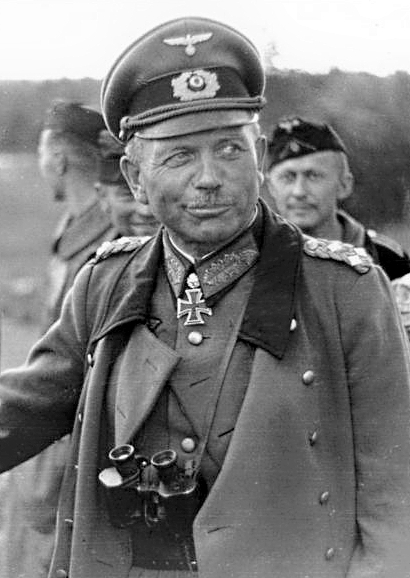
 Heinz Guderian
Heinz Guderian was born 17 June 1888 year in Chełmno. His father, Friedrich, He was a professional officer in the Prussian army. Despite, that the family did not have any military traditions, He decided to choose an army career for his son. Young Heinz is already in 1901 year he joined the cadet school in Karlsruhe. Two years later he began studying at the main school of cadets in Gross Lichterfolde near Berlin. W 1907 The year was finally admitted to the army, where he was assigned to 10. Hanovers' Infantry Battalion (whose commander was the father of Guderian). From April to December 1907 year he studied at the Metz War Academy. Having received the rank of lieutenant, he returned to his branch 27 January of the following year. In October 1912 of the year, Guderian was moved to a radiotelegraph company. W 1913 year married Margarete Goerne, which later gave him two sons. In October of that year he left the company and was sent to the War Academy in Berlin. There he studied until the outbreak of the war (Later, a year 1918 He returned to the complementary course).
Despite, that Guderian was trained for service in a light infantry, At the beginning of the First World War, it was assigned to 5. Cavalry division as a radio commander. Then he was moved to the wireless communication company. So he was rarely on the first line of fighting. He managed to get baptism during the fighting on the Markna River and in the battle of Verdun. For that, bravely repelling the attacks directed to his unit, He deserved the Iron Cross of the Second I and I class.
After the war, Guderian was from September 1918 year to May of the next year the main commandant of the Border Guard in Berlin, Wrocław and Bartenstein. Then he returned to the staff. His career dragged on at an incredibly slow pace. For a year 1915, When he got a promotion to the rank of captain, He didn't advance. Only in 1922 a year, something has changed in his life – He was appointed by the Motor Transport Inspector to develop ways of using car transport in the event of a possible war. These were Guderian's first steps in the field of tactics. This occupation initiated his great passion for the automotive industry, tanks and strategies. Since then, he passionately read works devoted to these aspects of the military, He also wrote a lot himself. He was convinced of the powerful strength and importance of tanks during the fighting.
The then authorities, Seeing the talent of Guderian, they appointed the function of a lecturer in military history and tactics in the staff. There he won the reputation of a great teacher. Soon (1927 year) He began to put a tank tactics in the Motor Transport Staff at the Ministry of War. Wanting to try your hand as a commander, After acquaintance, he received command over 5. Motorized battalion. The next step in Guderian's career was the day 1 II 1931 year, When he became the Chief of the Main Staff of the Inspection of Motorized Units.
1 IV 1933 year, Already after Hitler came to power, Guderian was promoted to the rank of colonel. Since then, he was promoted every year, until 1941. 1 July 1934 He was appointed chief of staff in the newly created command of the armored forces. Namowy Guderiana, to focus the reinforcement on tanks, they encountered a response soon; w 1935 The first three armored divisions were created in the year, and Guderian was entrusted with command 2. Goddess. Panc. Stationed in Wuerzburg.
W 1937 roku guderian, Already as a general and commander of the 16th Corps, He published his famous book “Danger – Panzer!”, in which he included the ideas of his tactics “Blitzkiegu”, or instant war. Book, providing the significant value of the tanks, was to convince society and authorities about the need to create as many tanks as possible. It was thanks to Guderian developed by Tactics that Hitler managed to conquer almost all of Europe.
Guderian commanded German forces during the annexation of Austria and Czechoslovakia. Shortly before the outbreak of World War II, he was appointed the head of the fast army.
Heinz Guderian during the September campaign and fighting in Western Europe was at the head of the 19th Corps. In September 1939 his unit was detained by a group of 720 Polish soldiers near Wizna. He did better in France, where the rallies of his tanks perfectly removed all the resistance of the French (He was moving so fast, that Hitler even ordered him to release the pace, threatening to take the command over the unit).
Guderian showed his excellent tactical abilities during surgery “Barbarossa”, When is it, having one step lower than the Feld Marshal, Commanding his panzergrupe Guderian, he moved deep into the USSR, that he gained the nickname “Fast heinz”. For his achievements in July 1941 year he received the knightly cross of the Iron Cross with oak leaves. 5 October of that year took command of 2. Armored army, which he greatly led to victories. Unfortunately, At the end of the year he was taken away from command – Guderian, Despite the clear directives of Hitler, he gave the order to retreat to the West, seeing, that the situation, in which the German troops were hopeless. Hitler was furious; The issue was worsened by the conflict with the von Kluge Field Marshal. He returned to active service after the Stalingrad defeat. He was appointed 1 mark 1943 Year General Inspector of the Armored Army, in which he was responsible for the further development of the Reich's armored forces. According to his own recommendations, he controlled the production of tanks and crew training.
21 July 1944 year, The day after the unsuccessful assassination at Hitler, General Guderian was appointed the head of OKH, in which he inspired the creation of Volksturm. 23 mark 1945 of the year he was deprived of this position by Hitler; Fuehrera was irritated by the general's persistent appeals to start peacetime negotiations. Guderian withdrew from public life and went to Tyrol, where he was arrested by the Americans of the day 10 house 1945 year.
Despite the objection of the Soviet authorities, Heinz Guderian was not tried as a war criminal. After the German surrender, he was taken to the United States, where he spent three years in the local prison, as a prisoner of war. Released in 1948 year he lived in Germany, where he died 14 house 1954 year in Schwangau. He published the stories of his life in the book. “Memories of a soldier”. Undoubtedly, he was the most outstanding commander of the armored troops and a specialist in war and war tactics.