 German plans
In March 1939 year, The Supreme German Command began work on “Fall Weiss”, that is, the operational plan of the war with Poland. However, Attack plans have already been developed, However, only from that moment they became official. In the plan “Fall Weiss” former strategies have been included, and new, created before 1939 year.
According to preliminary assumptions, Wehrmacht had to conquer Poland in the shortest possible time, or at least make her like that, That it would be certain, that this war would lose. Hitler spoke: “within 8 do 14 Days for the whole world must become clear, that Poland is threatening to break down; The operations themselves can of course last longer (6-8 weeks)”. This rush was dictated by the need to leave the eastern border of the almost unguarded (Only a group of army remained there “C” in the composition 34. reserve infantry division, with low states and poorly trained), In connection with the need to send most of the troops to Poland. German generals counted on the possibility of an offensive led by the French army, resulting from the country's obligations towards Poland. To this end, it would be necessary to conquer this country as soon as possible. This would allow you to show France, that her intervention makes no sense (because Poland would already be in a lost position) or – In the event of the French troops' attacks – Fast transmission of German troops to the western border. The developed Blitzkrieg technique would help in quickly mastering Poland, However, appropriate operational plans had to play an important role. Therefore, for decent preparation of the operation “Fall Weiss” enormous weight was applied.
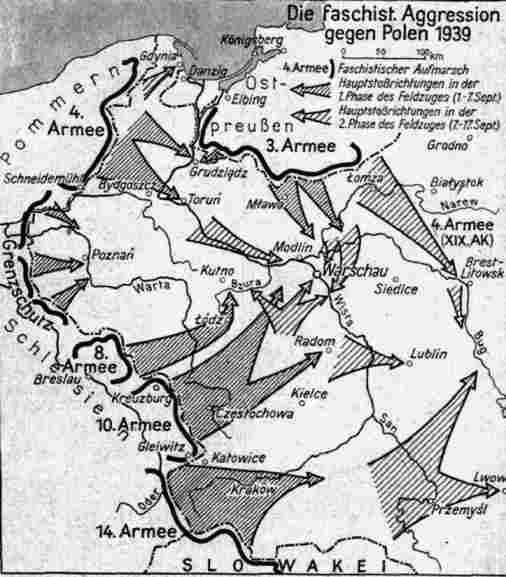
According to the operational plan “Fall Weiss”, German forces directed against Poland, counting 60 Large units, They were to be divided into two Heeresgruppe (Army groups): “Midnight”, in the composition 3. i 4. Army and “South”, consisting of 8., 10. i 14. Army. As the name suggests, Army group “Midnight”, General Fedor von Bock, She was to attack Poland from the north, being located in Pomerania and in Eastern Prussia. While a group of army “South”, under the command of General Gerda von Rundstedt, attacking from the south, was located in Lower Silesia and Slovakia.
In the first phase of the campaign, 3. General Georg von Kuehler's army, Leaving East Prussia, it was designed to eliminate the points of Polish resistance in northern Mazovia. However, the 21st corps, which is part of it, was to move east, the purpose of joining as soon as possible with 4. Army of General Hans von Kluge, aimed at liquidation “corridor” dividing Pomerania and Eastern Prussia, thus isolating the Polish part of Pomerania. Another task 4. Army, Already after connection with the 12th body, There was a break through the Vistula to Warsaw.
Task 8. Army, General Johannes Blaskowitz, located in the northern part of Lower Silesia, in the vicinity of Zielona Góra, It was purely protective. From the north, the army was to provide connectivity with 4. Army and prevent Poles from isolating it, From the south, however, it was to be a defensive force for the left wing of the main stormtroop – 10. General Walter's Army von Reichenaua. 10. The army was by far the strongest of all participating in the campaign. It consisted of 6 Infantry Division, 2 armored divisions, 2 motorized divisions and 3 light division, It was equipped with half of all tanks intended for fighting in Poland. Her task was to conduct the main attack, Going straight to Warsaw. From the south she was to protect her 14. General Wilhelm Army List, aimed, having missed Silesian fortifications, Mastering Lesser Poland.
The whole operation, According to the assumptions of the Blitzkrieg, Two air fleets were to protect from the air (Air fleet): 1. (General Albert Kesselring) i 4. (General Alexander Loehr). Their first -rate task was to eliminate Polish aviation, and then the destruction of all communication routes combined with covering your own troops. After completing these tasks, Luftflotten was to destroy all goals of economic value, such as factories, or other industrial plants.
Moreover, in the area occupied by the Polish army, which would not yet be mastered by Wehrmacht, Subversive troops were to operate – the so-called. In Columna.
Skąd jest cytat ,,W ciągu 8–14 dni dla całego świata musi stać się jasne, that Poland is threatening to break down; same operacje mogą oczywiście trwać dłużej”? Widzę go już któryś raz w internecie, czy to jest z przemówieni Hitlera czy z jakiejś książki?