 Polish plans
You have to admit, that from the very beginning of the independent state, The Soviet Union was considered to be the greatest enemy of the Commonwealth. He was considered the only potential aggressor, with whom the war could cause some difficulties. That's why this, until 1936 year, the only plans in the event of an armed clash, developed in the Polish Main Staff, There were strategies of fighting with the Soviets. The war with Germany was almost completely rejected – After all, the German armed forces were not that strong then, To be able to threaten the independence of the Commonwealth.
Views in this matter changed only after the death of the current Supreme Commander and changes among the highest military in the country, When, in the face of the course of events, the real threat of attack on the part of the Third Reich began to be foreseen, which is in the stage of intensive arms.
The fact was, that 1936 It was a bit late to start planning the defensive war. General staff, In order to catch up as soon as possible, he began to act in full swing, to be able to develop an appropriate strategy. After two years of working out the potential Wehrmacht combat operations, which may take place in the near future, in the fall 1938 year (After claims from the German side) The so -called. plan “Z”, which is an operational tactics in the event of a war with Germany.
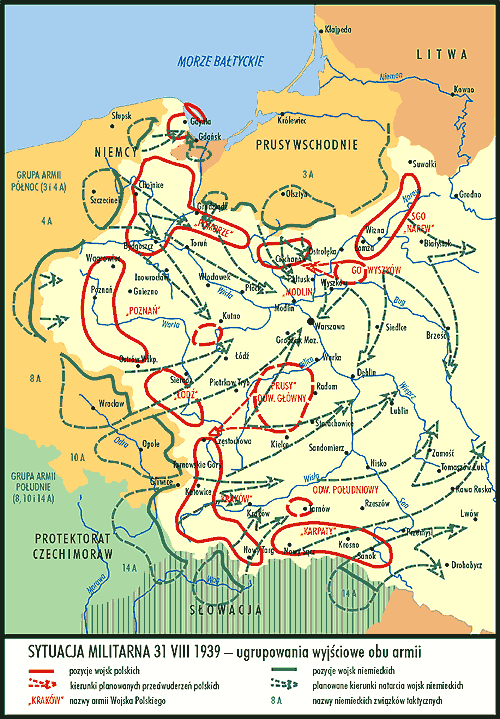
According to fundamental assumptions, presented by Marshal Rydz-Śmigły at a confidential meeting at the Royal Castle, In the event of possible German aggression on Poland, The Polish Army was to conduct defensive tactics, slowly going back deep into the country, slowing down the Wehrmacht march. The Polish Army was to avoid larger battles and conduct a coordinated retreat behind the Vistula in the south-eastern direction. In the meantime, France, After regrouping forces, She was to hit the West to Germany. This would result in a relief of the Eastern Front and enabling Poles to repel the enemy.
Plan “Z” thoroughly specified the distribution and behavior of the Polish Army troops. According to the assumptions, It was supposed to be divided into 7 army and one (greater) independent branch. North, in the corridor between West Pomerania and East Prussia, The army was located “Pomerania” under the command of Gen. Władysław Bortnowski, designed to cover likely actions towards Gdańsk and Pomerania. The army was to operate in the vicinity of Poznań “Poznań”, commanded by the gene. Tadeusz Kutrzeba. It was to take the main burden of German impact on Greater Poland, aimed at isolating the army “Pomerania”.
Area, where the center of gravity of the Polish troops was located, There was southwestern Poland. This area has become special for defense, For this was decided by both strategic considerations (the abdomen of the country, place of the most likely and strongest German attack), economic (Protection of areas such as COP, Upper Silesia, or South Polish industrial districts), and political (Protection of communication with Romania). They found their place there: Army “Łódź” (gen. Juliusz Rómmel), to defend Łódź at all costs and insure Warsaw and the army “Cracow” (gen. Antoni Sarling), whose task was to defend the Silesian agglomeration, Shielding a possible retreat for the Vistula, i – together with the army “Karpaty” gen. Kazimierz Fabryce – repel the attacks from Slovakia towards the fork of the Vistula and San.
In the north, however,, Possible attacks from East Prussia, directed into the country, the army was to be repelled “Modlin”, under the command of Gen. Emil Przedrzymirski-Krukowicz. It was to be supported by an independent operational group “Narew” (gen. Czesław Młot-Fijałkowski), located in the Suwałki region, and, constituting, Operating group “Wyszków”.
A fairly strong dehydration army was in the center of the country “Prussia” (gen. Stefan Dąb-Biernacki), to be thrown to battle in place, where it would be most needed, which was to be assessed in the first moments of possible aggression. In addition, a delay was located in the vicinity of Kutno “Kutno”, And in the fork of the Vistula and San, the southern dehydration.
As I mentioned, The actions of these branches were to be only delaying, For it would be impossible to stop German troops completely, which is easy to guess, Comparing the combat potentials of the Polish Army and Wehrmacht. The Poles were to wait for their front to relieve them of France's attack on Germany, whose character was described by the working protocol signed by France and Poland of the day 19 house 1939 year. He predicted, that the French troops will start actions “immediately”, And three days after the mobilization announcement, land forces will start. The French were to develop the fifteenth day “offensive actions by the main forces”.
The French's verbalness does not need to be distinguished.