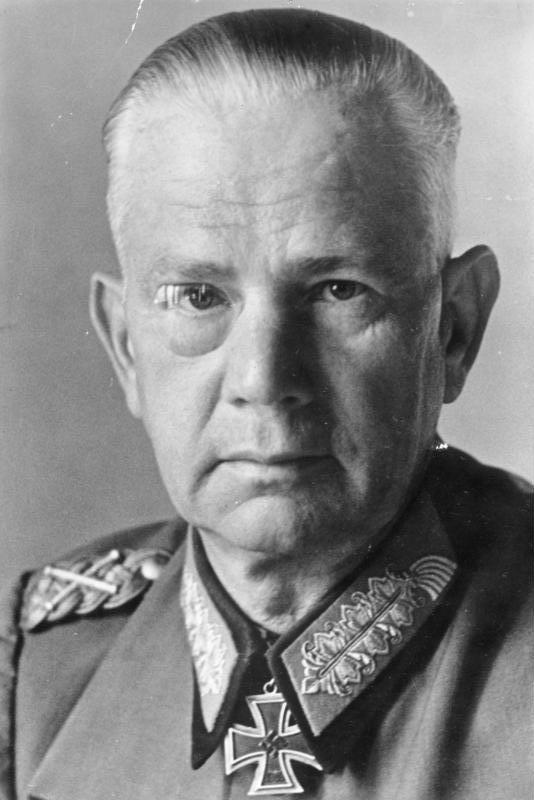
 Walter von Reichenau
Walter von Reichenau was born 8 October 1884 year in Karlsruhe. The fact had a significant influence on his adult fate, that he was the son of a distinguished Prussian general. At the age of nineteen, Reichenau joined the tsarist army, where he began his service as an artillery officer in 1. artillery regiment. Already in 1904 year he received an officer rank (lieutenant). The next promotion was only waiting for him nine years later, When, after graduating from three -year education at the Military Academy, he was promoted to the rank of lieutenant.
During the First World War, he at the beginning he served as an adjutant in 1. Artillery regiment. Still in 1914 he was promoted to the rank of captain and a referral to the General Staff 47. Reserve Infantry Division. Then he served in the staff 7. School Cavalry Division. For his merits during the First World War he was awarded the Iron Cross of the 1st and II class (both in 1914 year).
After the war, he remained in the army, entering Reichswehr – Armed Forces of the Weimar Republic. There, at first, he was an officer in the General Staff of the Border Branches in Pomerania and Silesia. In year 1920 He was transferred to the linear service, However, five years later he became a staff officer back. In the meantime, a year 1924 He received the rank of major, 5 years later he was promoted to the rank of lieutenant colonel and taking the position of the head of the Inspection of Communications Departments. He performed this function to 1931 year, When it was moved to a stationed one in Königsberg 1. Infantry Division, which 1 February the following year became the chief of staff. In the same eye he took the position of the Chief of Staff of the Military District in Königsberg.
When it slowly became clear, that Hitler will soon take the authority of Germany, Lieutenant. von Reichenau began to zealously declare himself as a supporter of national socialism, Perhaps under the influence of his uncle Friedrich, fanatical Nazi. Such an attitude paid off – Immediately after Hitler came to power, 1 February 1933 Reichenau took the role of the head of the office of the Ministry of War the Third Reich. A year later he received a general rank and became one of the most important characters in the German army. In the years 1933-35 He was the head of the management board of Reichswehr and Wehrmacht and was a personal adviser to the then minister of war, Werner Blombeg. He showed his undisputed support for Hitler von Reichenau in his eye 1934, When in June he persuaded his colleagues of officers to take an oath for loyalty to Fuehrer and took part in the so -called. “Long knives' night”, When at night on 29 i 30 June victim to Hitler SA victim to the conspiracy.
Then there were only promotions. 10 January 1935 of the year he became a lieutenant general and took command of 7. Army body stationed in Munich. W 1936 of the year, he was promoted to the rank of artillery general and appointed commander of the 6th Military District based in Munich. Two years later he took command of the 4th group of the army having his base in Leipzig. W 1939 year he was appointed German commander 10. Army.
He commanded his army during the September campaign. His task was to conduct the main attack on Warsaw. During the war in Poland, he committed many terrible crimes against civilians. For his merits 1 October was promoted to the rank of generaloberst and received (among others) Knight's Cross of the Iron Cross. During the French campaign, von Reichenau commanded 6. Army, which was supposed to carry out an effective offensive for Belgium and the Netherlands. As a reward for unusual achievements, he is promoted to the rank of Feld Marshal.
6. He also commanded the von Reichenau army during surgery “Barbarossa” w 1941 year. He was the perpetrator of the loud Massacre of Jews taking place in September in Kiev. 1 December was appointed, as the successor of von Rundstedt, commander of the German army group advancing to Ukraine “South”. In the initial phase of the fighting for Stalingrad, he commanded 6. Armored army, However, he lost this function after the opposing of Hitler's order and the reverse of his army from the Don. Soon after, 15 January 1942 year von Reichenau got a heart attack. He died two days later.