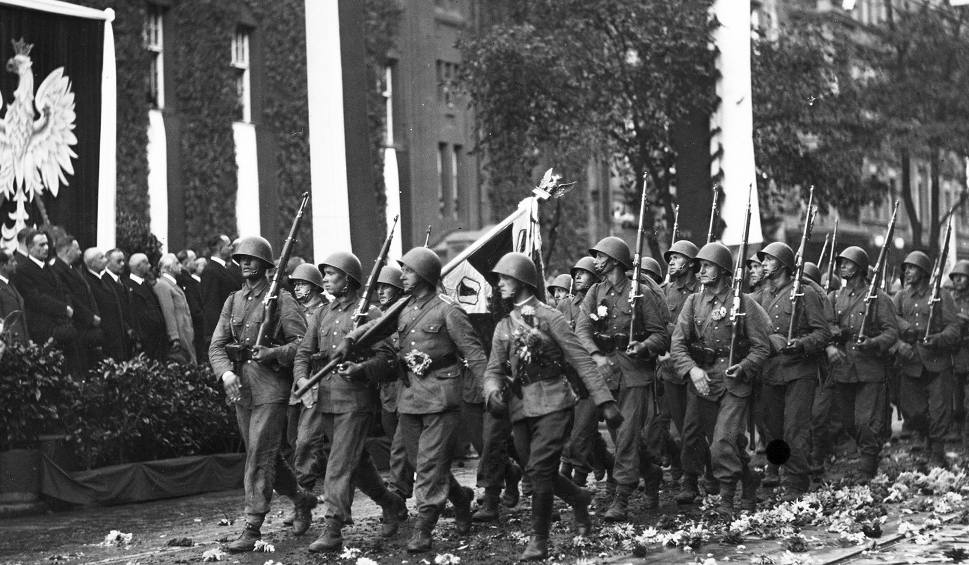
 Polish army
W 1939 year, The Polish Army was recognized by many international experts as one of the strongest and most battle European armies. It was in fact – valor, Hart spirit and excellent training of a Polish warrior, Demonstrated at numerous military maneuvers, he greatly impressed foreign observers. The French general Louis Marin stated in 1939 year, that a Polish soldier “He is first -rate, durable, endowed with a certain sense of the initiative, which cannot be found or a Russian soldier, nor German”. High notes of the Polish army also gave large peace states: 30 Infantry Division, 37 cavalry regiments and the elite Border Protection Corps (guarding the border with the USSR), about equivalent 3 division. The legend of the Battle of Warsaw was added to this 1920 year, When the Polish army chased the powerful Red Army, stopping her march to Europe.
And with 100 % righteousness can be said, that with such a great state of affairs Poland would certainly win the war, However, apart from excellent soldiers, there was still a matter of equipment and modernization of the armed forces, which stood in the Polish army, unfortunately, at a not very satisfactory level. It is sad to say sadly, that in this respect the Polish Army did not have the slightest chance in the clash with any strong European army.
In a way, Marshal Józef Piłsudski applied his hand to this, who could not ensure the proper development of the army. Army, whose terrible condition was made aware of in one of his conversations Marshal Edward Rydz-Śmigły, Piłsudski's successor, Having covered the rule after the death of the marshal in 1935 year. As he said, “He found a state of mobilization threatening the disaster (…); There was not a single anti -aircraft plot, Not a single peepana, except for the lumber from 1920”. Justification (or rather lack of action) Piłsudski can only be a fact, that the state during his rule was in a great crisis, so that in the face of huge expenses related to the need to rebuild the state, It was impossible to eliminate larger sums for the modernization of the army. However, The fact was, that the marshal completely neglected modern weapons, such as armored weapons and aviation. And there is no doubt, that if he wanted, Certainly he would be able to modernize the army.
Edward Rydz-Śmigły immediately joined the energetic actions, Approving in 1936 year 6-year plan to modernize the armed forces. He predicted, that after its completion, that is, in 1942 In terms of modernization, the Polish army will match other European armies. In the later time, the delay was calculated in advance, which assumed the completion of work in the year 1946 (however, Even if the war did not thwart the plans to modernize the army, It would not be possible to catch up with the Wehrmacht or the Red Army, For they also joined the violent arms during this period).
The main source of modern equipment for the army has become a specially erected central industrial district for this purpose, Located in the pitchfle of Wieprz and San. Contrary to appearances, The performance of native production in Poland stood, for economic possibilities, at a high level. At the time of Rydz-Śmigły's rule, almost a hundred modern 7-TP tanks were produced, Besides, over 300 aircraft (in this number 36 the most modern bombers “Moose”) and numerous artillery, including excellent cannons 37 mm wz. 36, produced in the country under the Bofors License License, Is anti -aircraft caliber 75 mm wz. 36 national structure. A modest navy was also strengthened, prepared for the war with the USSR (Only in contact with his army she could play any role). Part of the equipment was also imported from abroad, in this 100 French Renault R tanks 35, of which – unfortunately – only 49 managed to reach Poland before the outbreak of the war.
However, Despite the strenuous efforts, made to modernize the army, it was not possible to properly prepare the Polish Army for the war. The huge economic backwardness of the country stood in the way, as well as the conservatism of most senior officers and a lack of technical means. The army with modern equipment was not over., and the idea of the automotive cavalry has not been realized (It only succeeded with one brigade). Compared to the German army, which intensive reinforcements with full economic potential have already begun in 1933 year, or a red army, Polish army, modernized from 1936 year, with the small financial capabilities of the country, It was a little significant army.
The table below shows the number of tanks and aircraft in the Polish Army for the day 31 August 1939 year:
| Tanks | |
| typ | number |
| TK-3 | 156 |
| TKS | 234 |
| Renault 35 | 49 |
| Vickers | 34 |
| 7 TP | 98 |
| Planes | |
| typ | number |
| PZL P7 | 48 |
| PZL P11 | 128 |
| PZL P23 “Crucian” | 116 |
| PZL P37 “Moose” | 36 |
| Lublin r-xii | 49 |
| RWD 14 “Heron” | 35 |