Calendars in years of captivity
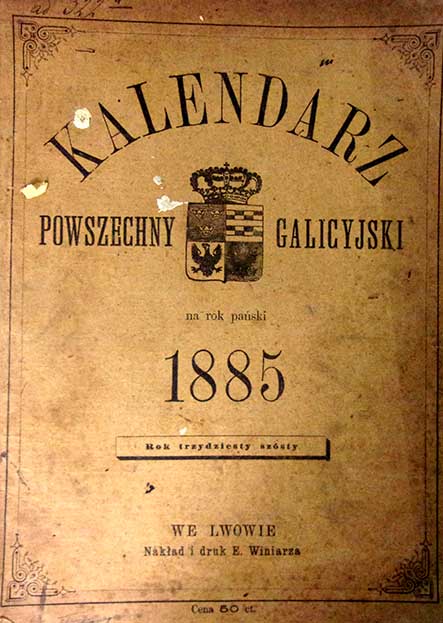
Huge, The already varied calendar production has not been inhibited by the partitioners. Calendars with tradition were still appeared. New ones also started to come out. Economic calendars have developed particularly, and in Galicia and Russian partitions of the first 19th century in. Even political calendars came out. Of course, others were now character. Rather, they contained lists of authorities and offices, Descriptions of cities and villages, lists of fairs and official tariffs, etc..
They were especially fashionable - from the 1930s - poetic calendars, modeled on the French "Muz calendar" (The first one appeared in France already in 1765 r.). They wore such titles: „Melitele”, "Znicz", "Better Than", "Non -memorials", "Niezabudka", "Primer" etc.. The latter appeared in 1838-1843 in Warsaw and was intended for the ladies.
There were also a lot of religious calendars, issued by various religious congregations and church institutions - devotional and conservative in content. After the enfranchisement of the peasants - in the 1950s and 1960s - "calendars for the people", issued by various clerical-Ziemiaan groups and centers. But there were and authentically folk calendars. This was undoubtedly the "Catholic calendar for the Upper Silesian people" (out of 1846 r. in Bytom and Królewska Huta) or "calendar for the Polish people" (Published by "Gazeta Rolnicza" in Warsaw). They were of great importance for the village, Being often the only prints, the Polish peasant came across. They played an extremely important role in the Prussian partition, Especially in Silesia, where national life began to wake up.
The traditions of old calendars - Zamojski - have also been reborn, Sandomierz, Kalisz and Królewiecie. He was still in Königsberg (from 1767) "Prussian-Polish calendar", in Kalisz - "Polish calendar, Russian and economic ”, in Stanisławów - "Universal calendar, home and economic "etc.. Supra -regional calendars were also published, m.in. "Gdańsk Calendar of Wiiarus of West Prussia, W. The Duchy of Poznań and Silesia "and" Calendar of Wielkopolska for Silesia ".
From 1830 r. Józef Czech calendars began to appear in Krakow, from 1852 and by Juliusz Wildt - "Universal calendar". The latter, According to the publisher's announcement, "Being a handy book", He brought home "science and fun, Hosts and council hosts and hosts, Citizens of regulations and government tariffs, trading in a list of fairs and ads, and religious and geographical news, Moral sentences and skill knowledge, industry and art for everyone ". The editor of this calendar was, among others. Władysław Anczyc.
From 1846 r. Józef Unger's "Popular Science Calendar" was very popular (appearing later under the name "Illustrated Calendar"), while from 1863 - "Calendar of the Warsaw Charity Society" (His editor was for some time, among others. Józef and. Kraszewski).
Agricultural calendars also appeared, for craftsmen, merchants and hunters, for ladies and women, farm and home, for the Polish and Catholic people, for all states, as well as for organists and Polish women. They were published by both church institutions, like newspapers and associations. Served specific social and religious purposes, but also promoting knowledge, raising education, culture and national consciousness. However, there were calendars full of obscurantic advice, almost alive from the old centuries. Even Wildt's "Universal Calendar" was not free from them, considered good after all, Whether (Anyway, only seemingly democratic) "Illustrated common calendar for all states" (also by the way Krakow).
There were also others, np. "Cheerful DIRCH" (published in Pleszew), "Home treasure" (in Mikołów) or "comfort of old age" (in Wrocław). Be such, as the Worksian “human Calendar illustrated”, "Humorant calendar flies for decent people", Lviv "humorous calendar of Śmigus" or "Cinderella Śląski" published in Opole. The calendars of Lucyna Ćwiercziakiewiczowa were also very popular (so, the one from the famous culinary recipes) and "Christmas carol for housewives" (issued from 1875 in Warsaw). Finally - numerous calendars issued by popular newspapers and weeklies, np. by "Catholic", "Nowiny Raciborskie", "Green Greek", "Chata" etc.. However, the records were broken by Warsaw calendars (issued in 1880–1909), how… „Facet”, "Girl", "Daughters of Ewa", „PST-PST”, "Corn", "Redoubt", "Tram" or "Vivat".
Wall calendars were also published. Starting from 1849 r. He gave them, among others. Krakow "Time", and then the Warsaw company M. Faience. They enjoyed great popularity in all partitions. Some of them were even distinguished by the aesthetics of performance. No wonder anyway, Because they were illustrated by such masters, like Franciszek Kostrzewski, Józef Chełmoński, Juliusz Kossak or Michał Andriolli. They also appeared - the English model - large format wall calendars, consisting of 12 cards decorated with lithographs. Currently fashionable calendars - commercials of various companies have an old pedigree.
At the end of the 19th. Workers' calendars also appeared on sale, published by the editors of magazines related to the workers' movement, like for example. Lviv "Robotnik" (from 1892 r.) or Katowice "Gazeta Robotnicza" (from 1902). However, this type of calendar became popular only in the interwar years of our century.